
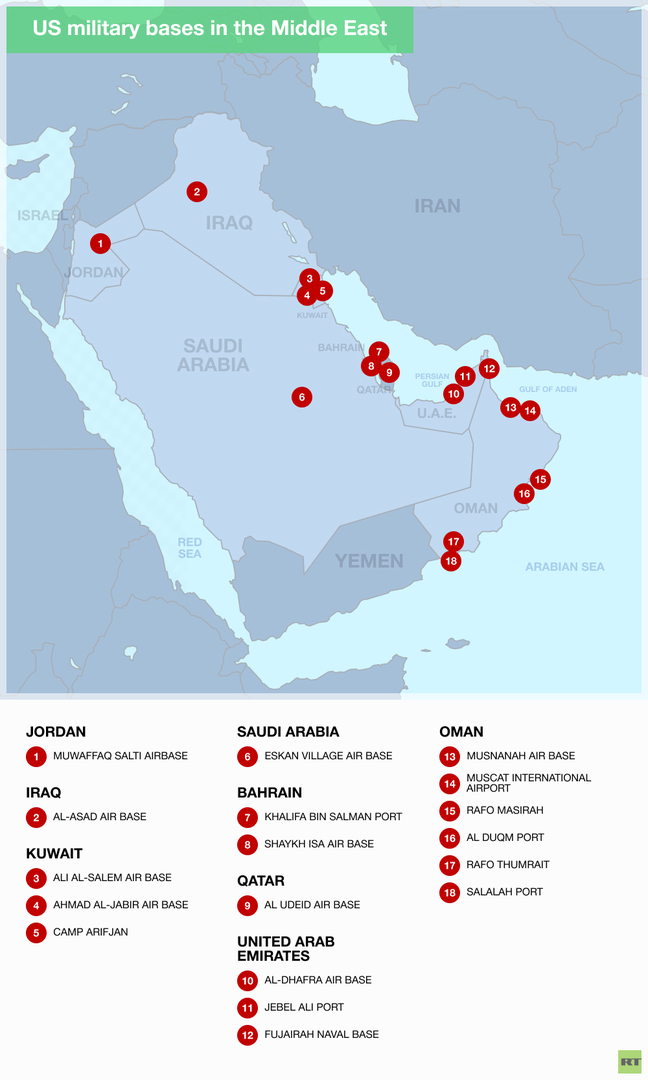
Amerikas Kriegsmaschinerie: Was wir über das US-Militärnetzwerk im Nahen Osten wissen
Die Vereinigten Staaten verfügen über eine Vielzahl von Stützpunkten und Einrichtungen in der Golfregion, von denen aus der Krieg gegen Iran unterstützt wird. Um welche Basen es sich handelt und welche Rolle sie im US-Militärnetzwerk spielen, zeigt folgender Überblick.
Von Dmitri Kornew
10.3.2026
Dmitri Kornew (bekannter unter der englischen Transliteration „Dmitry Kornev“) ist ein russischer Militärexperte, Gründer und Autor des Projekts „MilitaryRussia“
Die US-Aggression gegen Iran wäre ohne die US-Militärbasen auf dem Territorium der Golfmonarchien unmöglich gewesen. Diese Basen dienen als zentrale Ausgangspunkte für den Einsatz der amerikanischen Offensivkapazitäten. Die US-Militärpräsenz in der Region ist seit Langem ein strategischer Eckpfeiler der amerikanischen Politik. Ihr Ziel ist die Sicherung der globalen Ölversorgung, der Schutz von Verbündeten und die Abschreckung regionaler Bedrohungen, die laut US-israelischer Darstellung hauptsächlich von Iran ausgehen.
Die Fünfte Flotte der US-Marine ist ein Eckpfeiler der amerikanischen Militärpräsenz in der Region. Ihre Operationen erstrecken sich über den Persischen Golf, die Straße von Hormus und die umliegenden Gewässer. Wichtige Basen befinden sich in Bahrain, Katar, Kuwait, den Vereinigten Arabischen Emiraten, Saudi-Arabien und Oman und umfassen militärische Hauptquartiere, Einrichtungen kritischer Infrastruktur, Logistikzentren, Luftwaffenstützpunkte und Seehäfen. Im Vorfeld der Operation „Epic Fury“ gegen Iran rechneten die USA mit Vergeltungsmaßnahmen und reduzierten die Anzahl der Truppen und des Unterstützungspersonals auf diesen Basen erheblich. Die Stationierung zusätzlicher Offensivkräfte und Raketenabwehrsysteme hat jedoch zu einem signifikanten militärischen Aufmarsch der USA in der Region geführt.
Weiterlesen: https://gegenzensur.rtde.world/der-nahe-osten/272786-amerikas-kriegsmaschinerie-was-wir-ueber/
PDF: dk10.3.2026
******
Siehe auch:
Der Nahost-Krieg und die Folgen: Auch Deutschland droht Stagflation
Der Krieg im Nahen Osten wird länger und teurer als gedacht. Für den Kollektiven Westen, vor allem für die deutsche Wirtschaft, bedeutet dies eine harte Belastungsprobe. Für den normalen Bürger heißt das: noch sparsamer leben! Dafür können sie sich bei Trump und seinen europäischen Unterstützern bedanken!
Von Rainer Rupp
11.3.2026
https://gegenzensur.rtde.world/meinung/272684-auch-deutschland-droht-stagflation-durch/
PDF: rr11.3.2026
******
12. Tag im Angriffskrieg gegen den Iran
Von Peter F. Mayer und Jochen Mitschka
11.3.2026
https://tkp.at/2026/03/11/12-tag-im-angriffskrieg-gegen-den-iran-ticker-0700-uhr/
******
Warum der Iran den Krieg bereits gewonnen hat
Von Patrick Ringgenberg
(Assoziierter Forscher, IHAR, an der Universität Lausanne in der Schweiz)
8.3.2026
https://afsaneyebahar.com/2026/03/09/20706277/
******
Iran Has Served the US an Eviction Notice

By Pepe Escobar

March 10, 2026

https://sputnikglobe.com/20260310/pepe-escobar-iran-has-served-the-us-an-eviction-notice-1123802375.html


The new Supreme Leader of Iran, Mojtaba Khamenei, 57, chosen by the Assembly of Experts, so far has not spoken a single word in public.

The IRGC is speaking for him. From the start, Mojtaba was the preferred candidate to succeed Ayatollah Khamenei, the man who planned in meticulous detail how to break the Empire’s back.

The IRGC is now showing to the whole planet, especially the Global South, what was lying behind the “restraint" advised by Khamenei for years.

In a matter of days, the IRGC blinded US radars across the West Asia spectrum; weaponized the Strait of Hormuz, sending the global economy into a tailspin; and handed to Washington what for all practical purposes amounts to an intimation to surrender.

These are only some of the most prominent conditions for a possible ceasefire – assuming Tehran will ever trust the United States to comply:
-
Removal of all sanctions against Iran and release of all of Iran’s frozen assets.
-
Recognition of Iran’s right to enrich uranium on its own soil.
-
Full compensation for the damages caused by the imposed war.
-
Extradition of Iranian 5th columnists abroad, and the end of orchestrated media campaigns against Tehran.
-
No attacks on Hezbollah in Lebanon or Ansarallah in Yemen.
-
The dismantling of all US military bases in West Asia.
Let that slowly sink in. Here we have Iran telling the self-described, hyperbolic most powerful military in the history of the world to essentially surrender.

Now compound it with IRGC Aerospace Force Commander.

Majid Mousavi announcing that, “after neutralizing US air defense layers in the region, Iran is transitioning to a new missile doctrine. From now on, no missiles carrying warheads lighter than 1 ton will be used. Waves of missile attacks will be more frequent and more widespread.”

That is already translating, in practice, as the IRGC launching more Kheibar Shekan solid-fuel medium-range ballistic missiles, as it happened earlier this week on Tel Aviv and on the US Fifth Fleet in Bahrain.

The code for this first operation, significantly, was “Labbayk ya Khamenei”. That means “At Your Service, O Khamenei”. Read it as the first Iranian operation explicitly dedicated to the new Supreme Leader.

The Kheibar Shekan – range of 1,450 km - is road-mobile; ready to be launched from a truck in less than 30 minutes; flies under satellite-aided guidance with a maneuverable re-entry vehicle that executes terminal zigzag evasion at speeds the IRGC claims reach as much as Mach 10.

And yes: from now on it carries 1-ton warheads. That doubles the blast radius and the destructive power of each missile, as much as it doubles, or triples, or quadruples, the US-Israeli Interceptor Hell.

A Patriot PAC-3 interceptor costs $4 million. A THAAD interceptor costs $12.7 million. An Arrow-3 costs $3.5 million. They have all been methodically, serially destroyed by the IRGC.

In practice, from now the Epstein Syndicate needs to use more interceptors – that they don’t have - per each incoming missile to perhaps achieve the same probability of success.

And then there are the Khorramshahr-4 missiles: liquid-fueled, 2,000 to 3,000-kilometer range, carrying even heavier 1,500 to 1,800-kilogram warheads, with thruster-powered maneuverable re-entry vehicles.

We are talking about the heaviest conventional warheads in Iran’s arsenal, launched side by side with the upgraded Kheibar Shekans.

All in name of “Labbayk ya Khamenei”. The symbology speaks unmeasurable volumes.

Humiliation, Not Negotiation

These are the latest undeniable facts on the battlefield.

Assuming somebody in Washington with an IQ over room temperature bothered to explain them to the White House, it’s no wonder Trump is now bragging that the war is “very complete”. Incidentally, that happened after (italics mine) his 1-hour phone call to President Putin, requested by the White House.

Moscow’s read-out, delivered by the unflappable presidential adviser Yuri Ushakov, contains this jade pearl:

“The Russian president expressed a number of ideas aimed at achieving a prompt political and diplomatic resolution of the Iranian conflict, including taking into account the contacts he has held with the leaders of the Gulf states, with the president of Iran, and with leaders of several other countries.”

That’s diplo-talk for Putin telling the Americans some hard facts of life, and volunteering to find that oh so elusive off-ramp.

Assuming Tehran wants to play ball.

According to ceaseless Washington spin, the proverbial Beltway sycophants are urging Trump to "formulate a plan for the US withdrawal from the war”, announcing that "the military has largely achieved its goals” (even though they haven’t).

The fact is that the White House have already asked Turkiye, Qatar and Oman to relay American ceasefire proposals to Tehran.

The Iranian response is encapsulated here:

"Negotiations with the United States are no longer on the agenda."

Parliament Speaker Mohammad Ghalibaf: “We are absolutely NOT seeking a ceasefire. We believe the aggressor must be struck in the mouth so that it learns a lesson and never again even thinks of attacking dear Iran.”

Which brings us once again to why Trump endlessly bragging about “we’re winning”, would call President Putin as the war rages, and only a few hours after Putin adamantly proclaimed his “unwavering support” for Iran and the new Rahbar (“Leader”), Mojtaba Khamenei.

The answer, inevitably, is Trump looking for an exit-ramp. The absolute majority of the planet, as well as quite a few players across vassal lands, are already blaming the US for the collapse of the global economy.

That’s because the whole continuity of government, set in motion by the slain Ayatollah Khamenei, is supremely confident that they can bring down the Epstein Syndicate to its drenched-in-blood knees.

Ayatollah Khamenei pulled off what may go down in History as the greatest upset in 21stcentury geopolitics. All merit to his clarity of vision, endurance, self-sacrifice, and the mind-boggling meticulous planning of the mosaic defense strategy, now in effect.

What Iran under Mojtaba Khamenei – and that’s a national consensus – wants now is an unmistakable victory. The Empire of Chaos, Plunder and Permanent Strikes, with its “If I don’t like you, I kill you” ethos, must be thoroughly humiliated.
In Tehran, Iranians Struggle to Breathe After U.S.-Israeli Oil Facility Strikes

"By the time we finally packed our bags and locked the door, our fingernails were caked in chemical grime, and our lungs were burning just from breathing inside our own living room."

By Ariya Farahmand

March 11, 2026

https://www.dropsitenews.com/p/tehran-iran-oil-depots-israeli-strikes-toxic-acid-rain-breathing-chemicals


TEHRAN, IRAN—Saghar recalls the airstrikes that targeted oil facilities in and around Tehran on Saturday with a terrifying clarity. It was exactly one week into the U.S.-Israeli war on Iran and the constant roar of fighter jets overhead punctuated by loud explosions that rattled the windows had already become a familiar sound in the capital.

But at around 10:30 p.m. on March 7, three deafening blasts, distinctly larger than the strikes of previous days, shook her home. Saghar, 24, lives with her parents and sister in a residential complex in northeastern Tehran, perilously close to the Aghdasieh oil depot.

“The house shook, it truly shook. Far worse than an earthquake,” Saghar told Drop Site News. (Saghar is a pseudonym; she requested anonymity to speak with Drop Site News given the war.) “I remember the Tehran earthquake of May 2020—this was exponentially worse. The kitchen and living room windows shattered instantly, and the chandelier swung violently like a pendulum. My mother was at the sink washing dinner plates when the blast hit. The shockwave threw her so hard she landed head-first on the floor.”

A colossal orange flash ignited on the horizon. Israeli airstrikes had targeted major oil depots and infrastructure in the Tehran neighborhoods of Shahran, Aghdasieh, and Shahr-e-Ray, as well as in the nearby city of Karaj. The massive reservoirs of combustible fuel triggered apocalyptic-looking fires that raged throughout the night.

“My sister and I were in the living room. My father was lying down nearby. We rushed to my mother first, and my father slowly dragged himself over because his leg prevented him from walking easily,” Saghar said in a trembling voice. Her father, a combat veteran, had suffered a gunshot wound from the Iran-Iraq war in the 1980s that left him severely impaired. “For the first few seconds, my mother was completely dazed. We were paralyzed, not knowing what to do.”

They called emergency services and received triage instructions over the phone. “They told us not to move her, fearing a critical fracture. After about 15 minutes, each second dragging like a year, the paramedics arrived. Following an initial assessment, they loaded her into an ambulance and rushed her to a nearby hospital.”

Medical staff determined the head trauma was not critical, and Saghar’s mother was discharged after roughly 24 hours of observation. “While she was hospitalized, my father hired someone to reinstall the shattered windows,” Saghar said. “My sister and I packed our bags. As soon as my mother was discharged and cleared by the doctors, we planned to flee to Ramsar.”

Ramsar, located some 220 kilometers (136 miles) northwest of Tehran on the Caspian Sea, has become something of a safe haven in the escalating war. Tens of thousands of residents of Tehran and other cities have fled north to Mazandaran seeking shelter from the bombardment.

“Since the war began, we stayed in Tehran under the assumption that a purely residential complex wouldn’t be targeted,” she added. “We figured we were safe, with no military or security installations nearby. We never imagined a fuel depot nestled next to a civilian neighborhood would be bombed.”

When they returned to their apartment to pack, some nine hours after taking their mother to hospital, they found it blackened from the oil fires raging nearby. “Everything was coated in soot,” Saghar said. “Our white refrigerator was entirely black. If you ran your finger across any surface, it came away stained black.”

For two grueling hours, Saghar and her sister scrubbed surfaces and wiped down appliances. Wet rags became instantly soaked with heavy, black sludge as they tried to clean the thick, greasy layer of airborne crude. “We went through rolls of paper towels and bottles of detergent, but the oily film just smeared before it lifted,” she said. “By the time we finally packed our bags and locked the door, our fingernails were caked in chemical grime, and our lungs were burning just from breathing inside our own living room.”

Acid rain and a city gasping for air

When Tehran residents awoke the next day, March 8, they found a city robbed of daylight.

“When I woke up, the house was so dark I assumed it was heavily overcast,” said Sina, a 42-year-old father to a five-year-old, who lives in the Sattarkhan neighborhood in central Tehran, far from the burning depots. “I showered and dressed for work. But the moment I stepped outside, I panicked. A mixture of smoke and clouds, but overwhelmingly thick smoke, had blackened the entire sky.”

Sina, who gave his first name only, continued, “The air smelled horrific, but it wasn’t just the smell. A brief rain shower had turned everything greasy and black. My white car was covered in dark, oily spots.”

The Iranian Red Crescent issued a warning on Sunday for Tehran residents to stay indoors, saying that the explosions had spread “toxic hydrocarbon compounds and sulfur and nitrogen oxides” in the air. The group warned that any precipitation would result in highly dangerous acid rain capable of causing chemical skin burns and lung damage. It also encouraged people to protect exposed food.

“The streets were deserted. It took me about 15 minutes to reach my office, and by the time I arrived, my throat was burning and my head was pounding,” Sina said. “I immediately called my wife. She’s staying home these days to take care of our son. I woke her up, warned her about the toxic smoke, and told her to seal all the windows. She said the baby was still sleeping.” Two days after the attack, Sina said his chest still felt heavy, and he was struggling to breathe normally.

On Monday, the head of the World Health Organization, Tedros Adhanom Ghebreyesus, put out a statement on social media about the dangers posed to the nine million residents of Tehran and its surrounding area: “Damage to petroleum facilities in Iran risks contaminating food, water and air—hazards that can have severe health impacts especially on children, older people, and people with pre existing medical conditions. Rain laden with oil has been reported falling in parts of the country.”

Since the start of the war, Tehran has been the most heavily targeted location of the U.S.-Israeli aerial campaign. As in other cities, residential areas and civilian infrastructure in the capital have not been spared the relentless bombardment. Hospitals, shops, schools, public squares, and residential buildings have all been hit, in addition to government buildings. But the oil facility strikes were impossible to escape. Iran’s Department of Environment formally declared the strikes a violation of human rights, citing the Geneva Conventions.

Sara, 36, had been sheltering for a few days with her husband at their home in the Tehran neighborhood of Ekbatan, far from the targeted oil facilities. “My husband and I had planned to go grocery shopping on Sunday morning—meat, fruit, basic essentials. We’d been cooped up for two or three days,” Sara, who only gave her first name, told Drop Site. “When I saw the air on Sunday morning, I told him it wasn’t safe to go outside. We postponed it. By evening, the soot in our neighborhood seemed to have cleared, and we could see patches of blue sky, even though we could see other parts of the city were still smothered in smoke. We decided to make a run for it.”

Sara and her husband, Mehdi, walked to the grocery store about five six minutes away. “Our breathing became incredibly heavy. We felt like we had been doing grueling manual labor after walking for only five minutes,” she said. “We bought face masks on the spot and wore them the entire way back.”

Sitting in her two-bedroom apartment with her husband, Sara displayed her hands that were inflamed and covered in hives. “I have an old allergy that used to bother me, but it had been dormant for a long time. A few hours after getting back, my hands started itching intensely, turned red, and broke out in these hives,” she said. Her forearms were scratched raw while Mehdi suffered from labored breathing and a severe headache.

“Despite the blue sky, it felt like acid had been poured down our throats,” she said.
 Amir Mortasawi (alias Afsane Bahar) (امیر مرتضوی (افسانه بهار